
EVIAS develops automated high-power charging systems embedded directly into the road surface.
Our technology enables vehicles to connect automatically, charge efficiently, and operate with reduced battery dependency. Below are answers to common questions about deployment, compatibility, safety, and system design.
Explore answers to key questions around:
Compatibility & Deployment

EVIAS is a clean-tech company specializing in dynamic fast charging solutions through conductive Electric Road Systems (ERS). Our patented technology enables charging while the vehicle is in motion, allowing smaller batteries, reduced downtime, and scalable electrification for transport fleets.
We serve cities, infrastructure operators, and OEMs seeking cost-efficient, future-ready EV charging infrastructure.
Our dynamic fast charging system is compatible with all types of electric vehicles, including electric trucks, buses, vans, and utility fleets. EVIAS supports both retrofitted and OEM-built vehicles, offering a versatile solution for public transport operators, freight carriers, and logistics providers pursuing electric fleet infrastructure.
EVIAS technology is designed for flexible deployment across various environments — including city streets, national roads, ports, logistics corridors, and airports. Our conductive EV charging infrastructure only requires short road segments to be electrified, minimizing installation cost and disruption while maximizing coverage.
Yes. EVIAS systems are already deployed in real-world environments in Sweden and France. Our solution has reached Technology Readiness Level 7 (TRL 7), meaning it has been demonstrated under operational conditions and is ready for commercial scaling.
System Integration & Practical Questions
NEW
The rail is protected by a flexible rubber sealing strip along the top surface, preventing dirt and debris from entering the system.
For periodic maintenance, a simple dedicated cleaning tool can be used. The system is designed for outdoor durability and year-round operation.
Yes. EVIAS uses standard CCS communication protocols between the vehicle and the charging infrastructure.
This ensures compatibility with existing electric vehicle standards and seamless system integration.
Yes. The original charging socket provided by the vehicle manufacturer remains fully operational.
EVIAS complements existing charging systems — it does not replace them. Vehicles can continue to use conventional charging infrastructure whenever required.
Each rail segment is approximately 2 meters long and 15 cm wide and high.
The modular design allows flexible installation depending on the operational environment.
The collector mounted under the vehicle is fully removable and designed for easy reinstallation.
It can be detached and transferred to another compatible vehicle, supporting fleet flexibility and long-term asset optimization.
The system connects to a standard external charging unit linked to the power grid.
The in-road rail is installed within the pavement surface, and only short segments need to be equipped depending on operational requirements.
No overhead lines or bulky roadside equipment are required, preserving available space and simplifying integration into existing transport environments.
Safety & Reliability
Safety is our top priority. The conductive track is only powered when a vehicle is connected, preventing any risk of stray voltage. The system has been tested in extreme weather conditions — including snow, rain, heat, and dirt — and performs reliably year-round.
EVIAS also ensures passive and active safety through real-time monitoring and system diagnostics.
We collaborate with cities, transport authorities, fleet operators, and infrastructure developers to design and deploy dynamic EV charging infrastructure tailored to their needs.
A key example is our partnership with Troyes Champagne Métropole, where EVIAS will electrify utility and public transport fleets by 2026–2027. Contact us to explore how we can support your transport decarbonization goals.
Technology & System Design
An Electric Road System (ERS) is infrastructure that supplies power to electric vehicles in motion or at rest — turning driving time into charging time.
ERS technologies include:
- Overhead line systems: power delivered via cables above the vehicle (like trams)
- Inductive systems: wireless power transfer through coils embedded under the road
- Conductive systems: electricity transferred through direct physical contact between the road and the vehicle
ERS enables continuous charging without long stops or oversized batteries, making it ideal for logistics, freight, and public transport fleets.
Conductive charging in an Electric Road System involves direct physical contact between an energy supply unit in or on the road and a receiver on the vehicle — a kind of electrical handshake. This setup allows vehicles to charge efficiently while moving.
While all conductive ERS solutions rely on this principle, EVIAS’s system stands apart: it requires no onboard charger, reducing vehicle weight, cost, and complexity. Our embedded rail in the road is also designed so that no electrical components are exposed or touchable, ensuring superior passive safety.
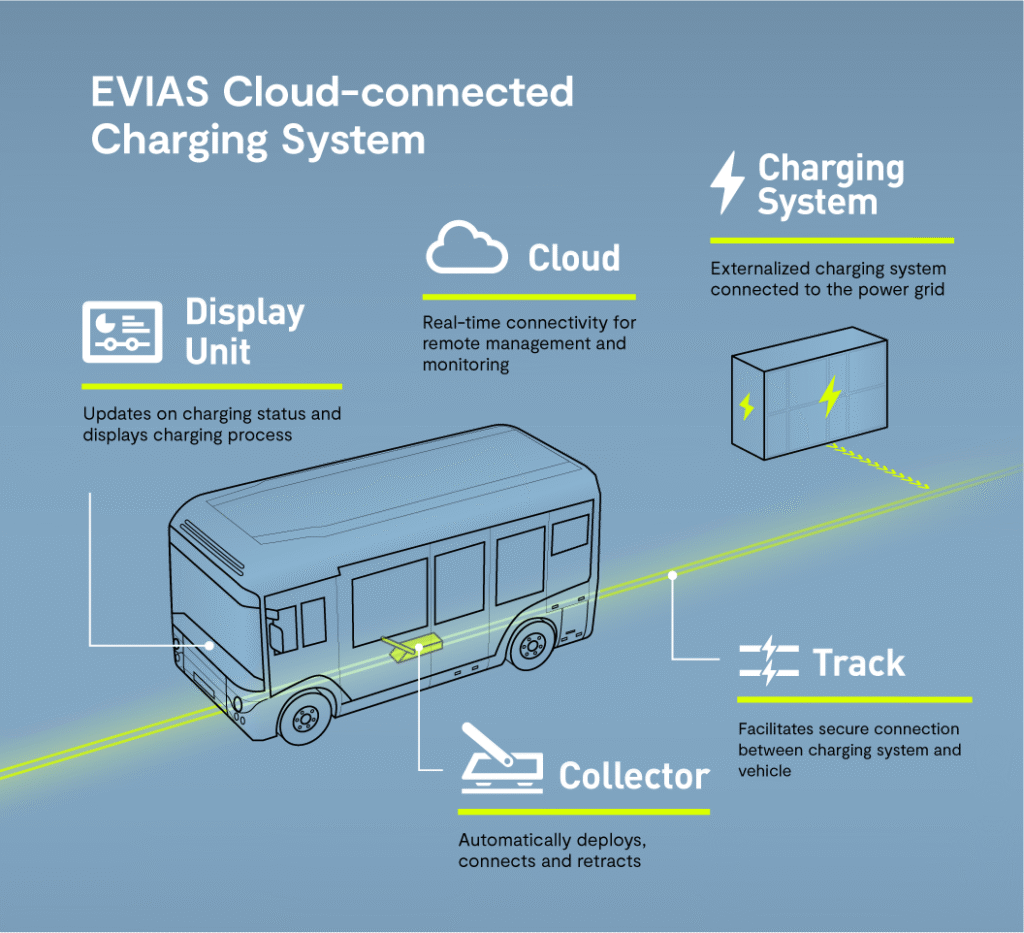
EVIAS delivers a complete system optimized for maximum efficiency with minimal infrastructure:
- No onboard charger required — reducing vehicle complexity and allowing up to 60% smaller battery size
- No electronics in the road — just simple, durable tracks that are easier and cheaper to maintain
- Over 1,000 kW charging power — which means only short segments of road need to be electrified
- Compatible with all vehicle types — retrofit or OEM-built, avoiding the need for specialized fleets
The result: significantly lower total cost of ownership for operators, cities, and infrastructure partners.
| Charging Method | Power Transfer Type | Key Benefits | Key Limitations | Onboard Charger Required? |
|---|---|---|---|---|
| Static Plug-in | Manual cable connection at station | Widely available, standardized | Requires stopping, long charge time, large battery | Yes |
| Overhead Line (ERS) | Cables above the moving vehicle | Proven in transit networks | Visually intrusive, lane restrictions | Yes |
| Inductive (ERS) | Wireless coils under the road | No physical contact | Low efficiency, high cost, complex electronics | Yes |
| Conductive (General ERS) | Direct contact on the surface of road-mounted rail | High power, scalable | Exposed parts, onboard charger required | Yes |
| EVIAS Conductive (ERS) | Insulated Contact within embedded rail in road | High power, safer, no onboard charger | NA | No |
EVIAS chose in-road conductive charging because it offers the strongest mix of power performance, cost-efficiency, safety, and deployment ease — especially for high-usage fleets like freight and public buses.